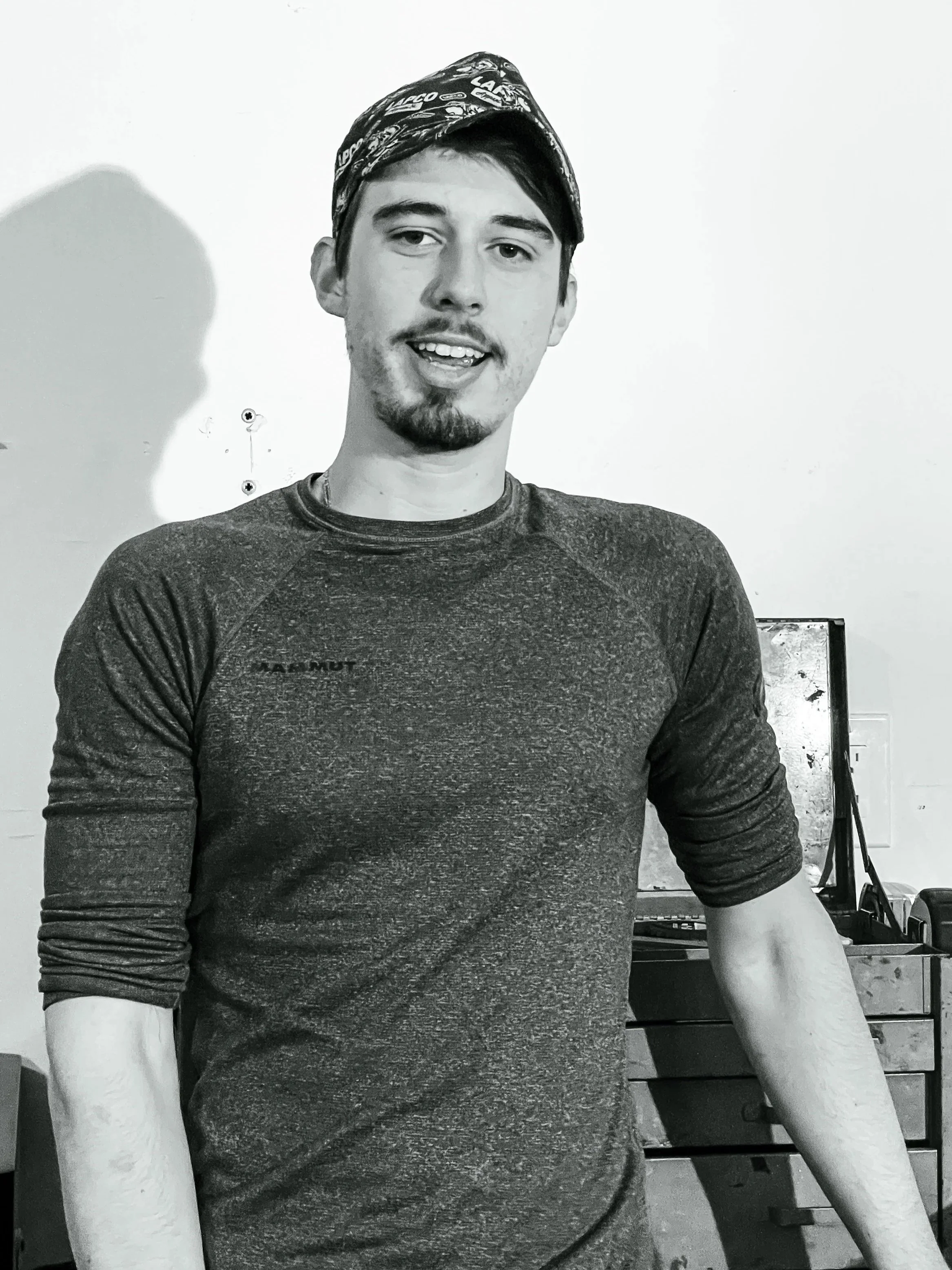
Where I Come From
I started in my garage at the age of 12. I needed to make a weld on my homemade motorcycle for it to be operational again, so the next logical step was acquiring a TIG welder with no experience or oversight, and being wholly confident I could weld it with ease. It wasn’t until failing with no help that I learned about shielding gas in TIG… I learned about sharpening the tungsten… It was a long time before I understood how to stick two pieces of metal together - at the time I would have benefitted immensely from a book on welding, or internet access, but now I am grateful for teaching myself. Rather, fabrication and welding itself taught me.
My Eighth Grade school project was a jet engine, which I designed and built from scratch using a turbo that I pulled from a junkyard with a hacksaw. It was booger welded stainless steel, but functional.
Welding got me through Highschool. I took Advanced Pipe Welding classes at Earlbeck Gases and Technology, Baltimore MD, Which counted towards my Highschool credits, and left there with 6G pipe certifications in TIG for carbon and stainless steel. While in Highschool I worked in a dimly lit welding shop doing government contract galvanized railings, and then a motorcycle repair shop - I wasn’t old enough to fill out any paperwork for either job.
My first fulltime position was in production manufacturing, where I welded from sun up to sun down - high-volume, thin sheet aluminum, quotas. I learned what ‘consistent’ really means when you have to prove it every day.
Then Living Design Studios, where I built and installed custom staircases, railings, and fireplaces for homes in Aspen. Copper, bronze, brass, stainless steel, aluminum. Patina applied by hand - gun bluing, aluma-black. Complicated geometries machined in-house. 3D design in Rhino when the project called for it. There I took classes at night, and graduated from The Community College of Denver — Associate of Applied Science in Welding Fabrication.
Most recently I started my own projects. I learned something important: I’d rather be the best welder inside an exceptional shop, than the owner of an ordinary one. That's not a concession. It's the clearer ambition. My drive is to prefect the small details, and surround myself with fabricators far beyond my years, with resumes that began before I was born. Perfecting my craft is my clear ambition.
Certifications
Certified in D1.1 6G carbon steel pipe, TIG, MIG. D1.1 6g stainless pipe, TIG. D1.1 4F/G FCAW, SMAW. D1.1 4F/G Aluminum, TIG
ASME Section IX — Boiler and Pressure Vessel Code, TIG, MIG.
Processes and Materials
TIG, MIG, FCAW, SMAW, Manual machining, Patina finishing, 3D design (Rhino, SolidWorks)
Copper · Bronze · Brass · Stainless Steel · Aluminum · Titanium · Structural Steel · Cast Iron ·
Metal Tells the Truth
Wood has knots, unexpected densities. Surprises that change the outcome. Wood is forgiving of imperfection - and sometimes produces it whether you want it or not.
Metal doesn't work that way.
Metal holds the possibility of perfection. A pinhole in a weld can destroy the product. Get it right, and it will do exactly what you tell it to do. Get it wrong, and it will show you, precisely and permanently, where your mastery ends. That's not a problem. That's the point.
Metal is the teacher. The material world schools you. I learned this early and have been studying ever since.
How I Work
Most welders see a weld. I see a system.
Before I mark a single joint, I’ve already mapped the whole project — how the parts relate, what order of operations produces the best outcome, where the problems will appear three steps from now if I don't address them here. I anticipate. I design the sequence before I execute the weld.
This is what makes me fast without being sloppy, and precise without being slow.
The principle is the same one that separates a great painter from an anxious one: you don't start by perfecting a single brushstroke in the corner. You block it in. Rough strokes first, broad structure, then progressively tighter focus until the details are exactly right. Trying to perfect each small part in isolation is how good welders produce slow, inconsistent work.
I move from the whole to the detail. I hold the system in mind while executing the part. That's a rare combination — and it's why shops that work with me find that things go wrong less often, and come together faster.
What I’m Looking For
A small, high-end fabrication shop where the standard is set by the work — not the schedule.
A place where precision is assumed, craft is taken seriously, and the people around the bench care about getting it right.
If that's where you work, I’d like to talk.